
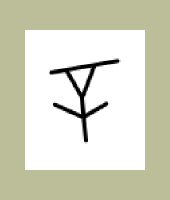
This Indus sign is based on the verb to stand or to establish, but it is upside down. Hence, it is an ideograph for the verb to topple.
Illustrative Text Reference:
Mohenjo-daro: Seal: M-306 a: Jagat Pati Joshi and Asko Parpola, 1987: Corpus of Indus Seals and Inscriptions: Volume 1: Page 76: Collections in India: Suomalainen Tiedeakatemia.
Comments:
This is Mahadevan's sign number 2086 which I have redrawn to better reflect the original.
There is only one extant example of this Indus sign.
I am not aware of this symbol in the corpus of modern Chinese characters. However, it can be seen in some archaic versions of Chinese characters. An example, from a bronze inscription, is the
character lóng 龍 (shown on the right). A lóng was a dragon. Dragons were often associated with earthquakes or floods. Hence, the link to the word topple. Perhaps the most famous
dragon-like being associated with a catastrophe is Gònggōng who is reputed to have knocked over a pillar holding up the sky, thus causing the earth to tilt.

Image Credits:
To Topple: Lynn Fawcett, 2017.
Jinwen (bronze) illustration for the character lóng 龍: Chinese Text Project Dictionary: http://ctext.org/dictionary.pl?if=en&char=%E9%BE%8D: Accessed: 5 August 2017.